
Why I Stopped Letting an Algorithm Choose What I Read
A quiet shift from algorithm-driven feeds to intentional reading, and what it changed in the way I consume, think, and pay attention.
There was a precise moment when I realized I was no longer really choosing.
I was scrolling through a news feed, telling myself I was “staying informed.” But what I was seeing did not really match my interests, nor what I had asked for. It was what an algorithm had decided to show me.
Targeted, amplified, hidden, or pushed content, according to opaque logics I did not control and that no one had really explained to me.
At the time, I did not have some grand revelation. It was more of a gradual discomfort. That strange feeling of no longer being fully in control of what I was reading, what I was discovering, and what was entering my attention.
I often summarize that frustration this way: the algorithm thought it knew better than I did what I needed. Which is not necessarily true.
Returning to a Forgotten Tool: the RSS Feed
I had put RSS feeds aside for a few years. Not because they stopped working, but rather because everyone seemed to have moved to social networks to stay informed, and I had simply followed the movement.
Like many people, I ended up confusing “being informed” with “being exposed to a feed.”
What brought me back to RSS was not a trend. It was exhaustion. The exhaustion of looking for value in a space built to maximize engagement, not understanding. The exhaustion of seeing certain creators disappear for no apparent reason, while other content forced itself onto me without me having chosen it. And sometimes, even when actively searching, no longer being able to find a specific post.
RSS is almost the exact opposite of that: no content you have not chosen.
When a site publishes an article, it arrives in your reader chronologically, without filters and without ads slipped between two posts. No “for you” suggestion that has nothing to do with what you came to read.
It is simple, almost austere. But that is precisely what I liked about it.
Taking Back Control of Your Attention
Digital sovereignty is not only a concept reserved for states or large companies. It also begins at an individual level, in the small choices we make with our tools, our habits, and our information flows.
We often forget that these small individual actions, repeated daily, are what eventually transform the habits of larger entities.
In my case, returning to RSS gave me the feeling of regaining a form of control. Not total control, of course. But at least some control over the entry point of the feed.
I choose the sources. I choose when I consult them. I am not pulled into an endless succession of recommendations. When I open my reader, I know why I am there. I do not really scroll. I consult what I have decided to follow.
The difference may seem subtle, but it is fundamental.
What I found again with RSS was not only a tool. It was another relationship to information. Less nervous. Less passive. More intentional.
In my case, I built a very simple system:
sources I consider “fundamental”: blogs and a few independent media outlets;
a short daily reading session, between 10 and 15 minutes;
a manual selection of what I want to keep in my PKM.
Nothing revolutionary. But that is precisely why it works: because it is simple.
Where to Start, Without Making It Complicated
I do not have a complex setup to sell. There are several options, depending on how you read and whether or not you feel like tinkering.
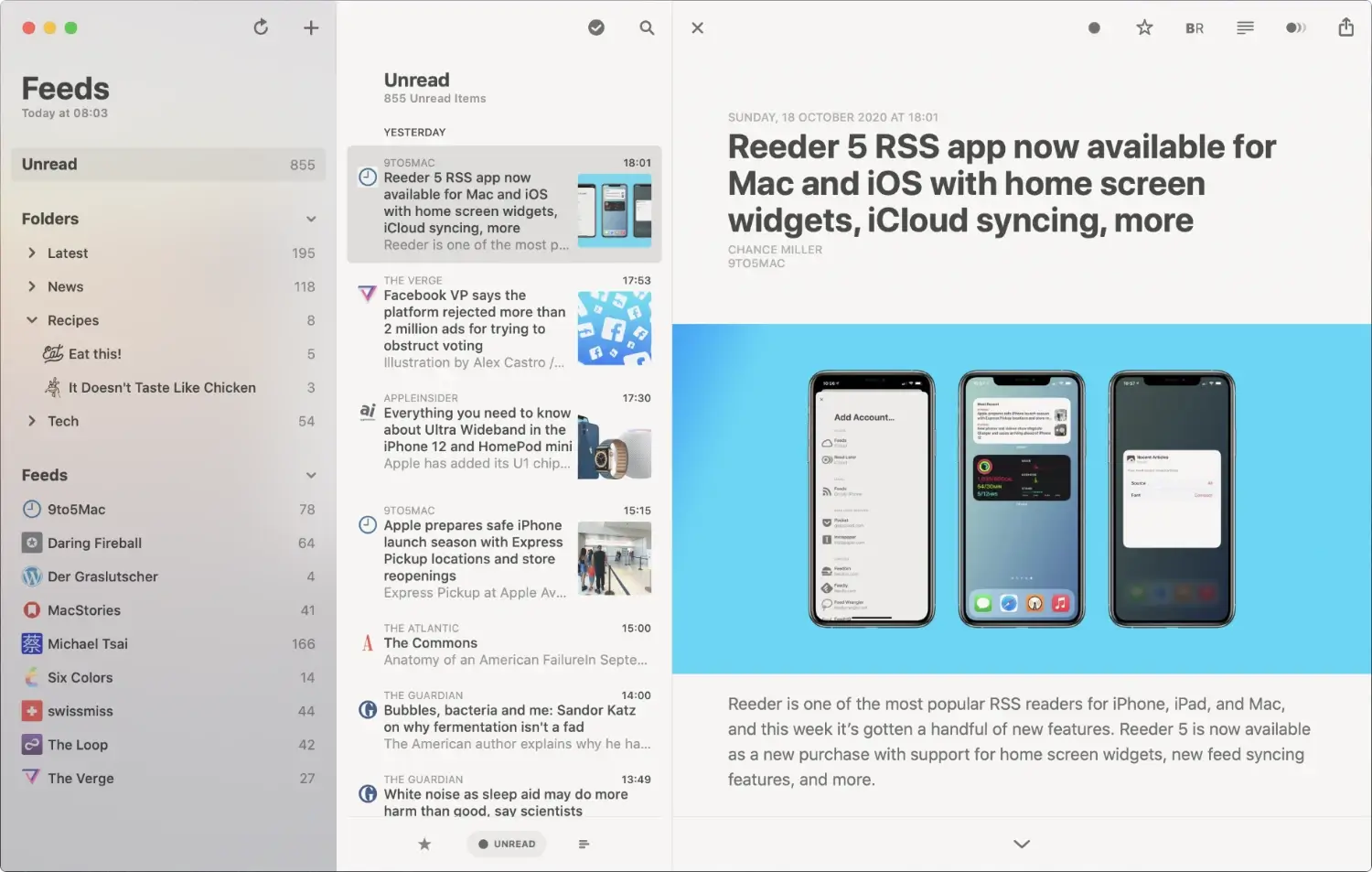
I currently use Reeder Classic on iOS and macOS. The interface is polished, fast, pleasant to read, and integrates very well into the Apple ecosystem. I also like being able to save some articles to “Read Later,” without turning the app into a bloated machine.
There is also NetNewsWire, which I used in the past. It is a free, open-source app, also available on iOS and macOS. It does the job very well if you are looking for something simple, clean, and distraction-free.
For those who prefer a more minimalist and self-hostable approach (A SaaS version is available if you don’t want to deal with self-hosting) Miniflux is an interesting option. It is an open-source RSS reader designed to stay light, fast, and free of unnecessary features. There is no hidden telemetry or disguised algorithm. Just a feed reader.
And if you want even less friction, Vivaldi includes a native RSS reader directly in the browser. No need for an additional app to get started.
The entry point is low. You can begin with just a dozen sources, then see whether this change of rhythm works for you.
The trap would be wanting to rebuild everything at once. I think it is better to start small, with a few genuinely chosen sources, rather than recreate another infinite feed somewhere else.
From Reader to Knowledge Base: RSS + PKM
This is where RSS stops being just a reading tool and slowly becomes a thinking tool.
The problem with passive reading, even when it is well curated, is that it does not always leave traces. We read, we forget, and sometimes we read again. Without a system to capture what matters, the best ideas end up slipping through our fingers.
The workflow I use at the moment is fairly simple: Reeder Classic → Obsidian.
Concretely, when an article interests me in Reeder, I open it in the browser. Then, with the Obsidian Web Clipper extension, I save the page directly into my “Clipping” folder. After that, I highlight the passages that matter, reread them, and sometimes turn them into atomic notes that may serve me later.
It is not only a way to archive. It is a way to turn reading into material.
For those who prefer to stay within a single environment, there is also the RSS Dashboard plugin for Obsidian. It allows you to read your feeds, save articles in Markdown, and integrate them directly into your vault without going through a third-party service.
I have not tested it yet, because I am currently on a kind of “diet” for my Obsidian vault. I am trying to keep as few plugins as possible, and I will probably explain that soon in a series of articles.
But the idea remains the same: no longer reading only to consume. Reading to build.
Each article can become a brick in a broader system of thought. RSS is the entry point. PKM is where something begins to take shape.
What About the Creator’s Side?
I talk a lot about the reader, but there is also the other side of the equation.
If you run a blog or publish content, offering an RSS feed is a form of respect toward your readers. It gives them a way to follow you without depending on a third-party platform.
No account to create, no permission to ask from an algorithm, and no news feed deciding whether your article deserves to be shown or buried.
They subscribe. They receive.
And that gesture is stronger than it may seem. If someone adds your blog to their RSS reader, it is not a passive impression in a feed. It is an intention. In a way, the digital equivalent of subscribing to a magazine you genuinely want to receive.
Technically, it is often already in place without you knowing it. Ghost automatically generates an RSS feed for every blog, accessible simply by adding /rss/ to your URL. Jekyll has the jekyll-feed plugin, which can generate a feed.xml file. WordPress, for its part, has done this natively for years.
If your blog runs on one of these tools, your feed probably already exists. The only thing missing, sometimes, is making it visible and not burying it in a footer or hiding it behind an obscure icon. Just a clear link, for readers who want to follow you differently.
In a context where accounts can be deleted, organic reach can be changed overnight, and platforms can be bought or transformed without warning, offering an RSS feed is not a technical detail. It is a small form of commitment.
What RSS Does Not Solve
It also needs to be said: RSS does not solve everything.
It does not filter for you. If you subscribe to sixty sources, you will have sixty sources to read. Curation remains your responsibility, and that is precisely why pairing it with a PKM system can make sense: one provides the flow, the other helps transform that flow into usable knowledge.
RSS does not automatically make you smarter. It does not guarantee that you will read better, or remember more. Above all, it removes a layer of intermediation.
Andrej Karpathy recently mentioned his return to RSS feeds to consume higher-quality content, with less algorithmic noise. What struck me about that idea is that it is not really about nostalgia. It is more about cognitive efficiency.
Attention is a resource. Managing it yourself rather than fully delegating it to a platform is a choice that has very concrete consequences on what we think, what we produce, and what we retain.
I do not believe RSS is a magical solution. I do not even believe it is for everyone. But I do think it raises a simple, almost uncomfortable question: who is really choosing what I read?
Since returning to this system, I read less randomly, less reactively. I read less because a feed caught me at the wrong moment.
And what I read feels more chosen.
The question I ask myself now is this: how many important pieces of content have I never seen because an algorithm decided they did not deserve my attention?